
 sale@henanminecranes.com
  +86 16627702870

What Is an RMG (Rail Mounted Gantry Crane)?
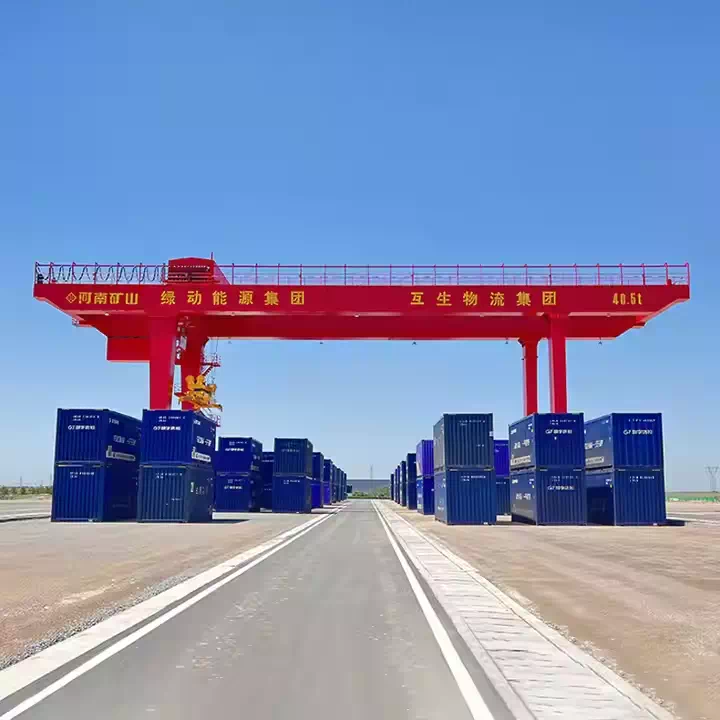
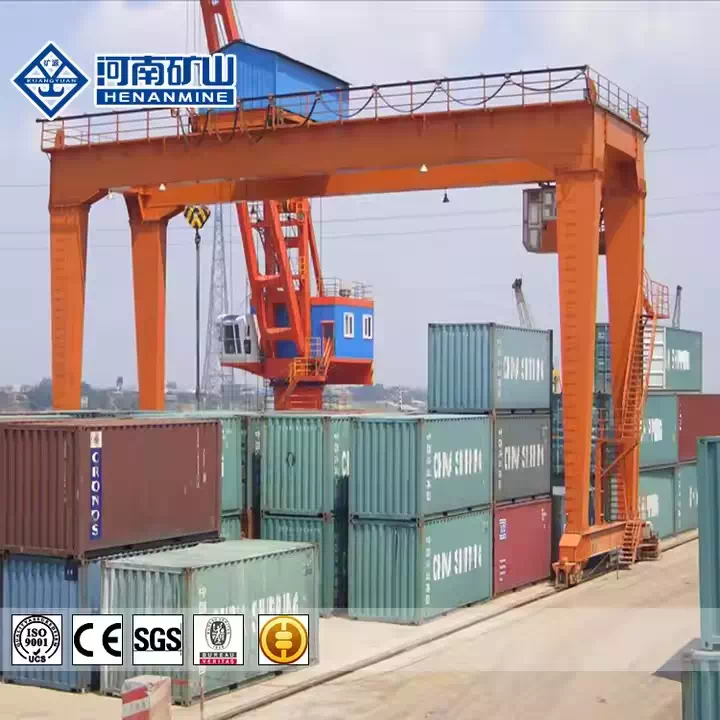
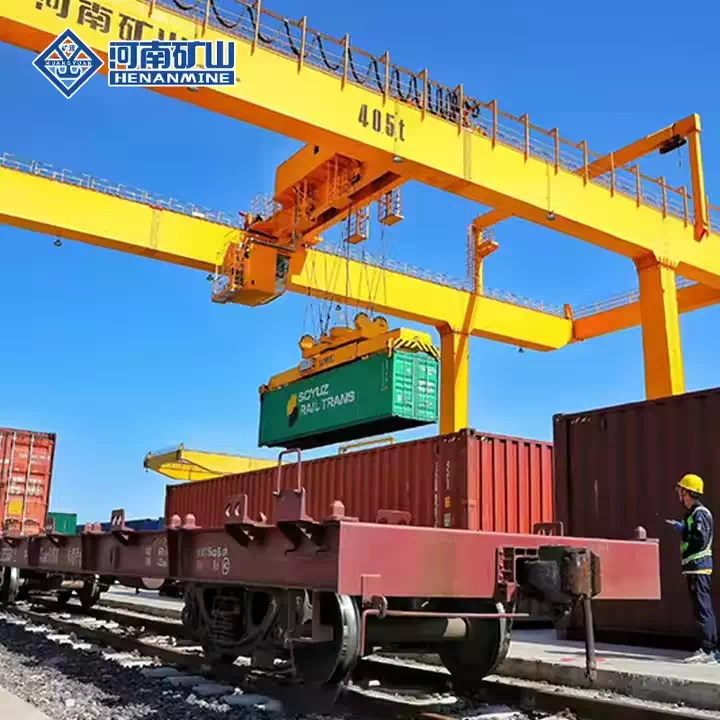
A Rail Mounted Gantry Crane (RMG) is a large, electrically powered crane that runs on a pair of fixed rails. It consists of a strong double‑girder bridge (or sometimes a single girder) supported by legs with rail wheels. The crane spans multiple rows of containers and a truck or rail lane, and its trolley travels across the span to pick up and place containers using a telescopic spreader.
RMGS are typically used for stacking containers in high‑density storage blocks, loading/unloading trains and trucks, and acting as a transfer point between different transport modes. They are especially common in automated container terminals because their rail‑guided movement makes them easy to control with precision sensors and software.
How Does an RMG Work?
The working principle of an RMG is simple yet highly effective:
The crane’s bridge spans across several rows of containers and usually a truck or rail lane.
A trolley moves back and forth along the bridge.
Hanging from the trolley is a telescopic spreader that can extend or retract to lock onto containers of different lengths.
The spreader lifts a container using four twist locks that engage the container’s corner castings.
The entire crane travels along the rails (longitudinal movement), while the trolley moves across the span (transverse movement). Together, they allow the spreader to reach any container position within the crane’s working area.
Core Components
1. Steel Structure – The Backbone
Double Girder Bridge (most common): Two parallel box girders made of high‑strength steel. Provides rigidity for wide spans (20–50 m) and heavy lifting (30–50 t).
Legs (Portal Frame): Four legs (or two on each side) that transfer the load to the rail wheels. Often A‑frame or straight‑leg designs.
End Carriages: Connect the bridge to the legs and house the travel drive wheels.
Cantilevers (optional): Extensions of the bridge beyond the rails, allowing the crane to serve trucks or railcars outside the main span.
2. Trolley & Spreader System
Trolley Frame: Moves horizontally along the bridge girders. Carries the hoist and spreader.
Telescopic Spreader: Hydraulic or electro‑hydraulic mechanism that extends/retracts to handle 20ft, 40ft, and 45ft ISO containers.
Twist Locks: Four rotating locks that engage the container’s corner castings.
Spreader Anti‑Sway System: Uses sensors and motor controls to reduce load swing during trolley travel.
Twin‑Lift Spreader (optional): Allows handling of two 20ft containers simultaneously.
3. Hoist Mechanism
Hoist Motor & Drum: Electric wire rope hoist (usually two ropes for stability).
Redundant Braking System: Electromechanical brake + mechanical load brake for fail‑safe operation.
Overload Protection: Electronic sensor that cuts power if the load exceeds rated capacity.
Hoist Limit Switches: Prevent over‑hoisting or over‑lowering.
4. Travel Drives (Gantry & Trolley)
Bridge Travel Drives: Heavy‑duty electric motors (frequency‑controlled) mounted on the end carriages. Drive the entire crane along the rails.
Trolley Travel Drives: Compact motors that move the trolley across the bridge.
Rail Wheels: Forged steel wheels with hardened rims, designed for low wear on steel rails.
Rail Clamps (wind brakes): Automatically engage to lock the crane in place during high winds or when parked.
Top Advantages of RMG Cranes
Why choose an RMG over other container handling equipment? Here are the most compelling benefits:
1. Maximum Stacking Density
RMGs can stack containers 1‑over‑6 or 1‑over‑7 (i.e., 6 or 7 containers high). This dramatically increases storage capacity per square meter compared to RTGs (typically 1‑over‑5) or straddle carriers. For terminals with expensive land, RMGs are the best choice.
2. Faster Travel Speeds
Because RMGs run on fixed rails, they can achieve bridge travel speeds of up to 120 m/min – much faster than rubber‑tyred gantries (20–30 m/min). Faster travel means shorter cycle times and higher throughput.
3. Lower Operating Costs
RMGs are fully electric (no diesel engines). They consume less energy than diesel‑hydraulic RTGs, and regenerative drives recover energy during lowering and braking. No tire replacement, no steering hydraulics – maintenance costs are significantly lower.
4. Superior Stability & Precision
Rails eliminate sway and steering drift. Even at high speeds, the crane moves in a perfectly straight line. This allows automated operation with laser or encoder positioning, enabling semi‑ or fully unmanned terminals.
5. Environmentally Friendly
Zero emissions at the point of use, low noise, and no hydraulic oil leaks. RMGs are ideal for green ports, urban terminals, or indoor facilities where diesel fumes are not allowed.
6. High Duty Cycle Capability
Built for continuous 24/7 operation (FEM A7‑A8). RMGs can handle the most demanding terminal schedules without overheating or excessive wear.
RMG vs RTG: The Complete Comparison
Many terminal operators struggle to choose between a Rail Mounted Gantry Crane (RMG) and a Rubber Tyred Gantry Crane (RTG) . Below is an exhaustive side‑by‑side comparison to help you decide.
| Feature | RMG (Rail Mounted Gantry) | RTG (Rubber Tyred Gantry) |
|---|---|---|
| Mobility | Fixed path – travels only on steel rails. Cannot change rows without switching tracks. | Free‑roaming – can move between container blocks via steering and rubber tires. |
| Stacking Height | 1‑over‑6 or 1‑over‑7 (6–7 containers high). Ideal for dense storage. | Typically 1‑over‑5 (5 high). Some modern RTGs reach 1‑over‑6 but with reduced stability. |
| Span | Wide – covers 6–10 container rows + truck lane (up to 50 m). | Narrower – typically 6 rows + 1 truck lane (approx. 23–30 m). |
| Travel Speed | Up to 120 m/min (bridge). Very fast. | 20–30 m/min (typical). Slower due to tire friction and steering limits. |
| Power Source | Fully electric (cable reel or conductor bar). | Diesel‑electric (engine + generator) or electric with cable reel (E‑RTG). |
| Emissions | Zero emissions at point of use. Clean and quiet. | Diesel RTGs produce CO₂, NOx, and noise. E‑RTGs (electric) are cleaner but still need cable management. |
| Operating Cost | Low – no fuel, no tire replacement, less maintenance. | Higher – fuel, tire wear, hydraulic steering repairs. |
| Infrastructure Cost | High initial – requires heavy‑duty rails, foundations, and electrical supply. | Low initial – works on compacted ground or pavement. No rails needed. |
When to Choose RMG?
You have a dedicated container block that will not change layout for many years.
Land is expensive, and you need maximum storage density (≥1‑over‑6).
You want low operating costs and are willing to invest in rails upfront.
You plan to automate the yard (fully or semi‑automated).
Your terminal operates 24/7 and requires high travel speeds.
Typical users: Large container terminals, automated stacking yards, intermodal rail hubs, empty container depots, high‑throughput inland ports.
When to Choose RTG?
Your yard layout changes frequently (e.g., expanding or reconfiguring).
You have a limited budget for civil works and want to start quickly.
You need the ability to move cranes between different blocks.
Your stacking height requirement is only 1‑over‑4 or 1‑over‑5.
You operate in a location where electricity supply is unreliable (diesel RTG can be refueled).
Conclusion
The Rail Mounted Gantry Crane (RMG) is a proven, high‑performance solution for any facility that needs to stack containers densely, move them quickly, and operate reliably for decades. Its rail‑guided stability, electric efficiency, and automation readiness make it the backbone of modern container terminals, intermodal yards, and industrial rail‑served warehouses.
Henan Mining Cranes Co., Ltd. is a leading crane manufacturer in China. With decades of industry experience, we have become a trusted partner in the global material handling solution field. We are committed to providing comprehensive professional services tailored to your specific needs. We recommend the most suitable crane products, offer accurate quotations, and design customized solutions. Welcome to contact us.
Get In Touch
Email: sale@henanminecranes.com
Website: https://henanminecrane.com/
Whatsapp:16627702870