
 sale@henanminecranes.com
  +86 16627702870

Choosing the right overhead bridge crane is one of the most critical infrastructure decisions you will make for your facility. It impacts productivity, safety, workflow efficiency, and your bottom line. While both Single Girder and Double Girder cranes perform the same basic function—lifting and moving heavy loads horizontally—they are engineered for entirely different applications.This guide will break down the structural differences, advantages, limitations, and key selection factors to help you make an informed decision .
A bridge crane is a type of overhead crane that includes two or more overhead runways built into the building’s support structure. Bridge cranes have different configurations and can be comprised of one or two beams—more often referred to as a single girder or double girder design. Girders can be made of rolled steel or can be fabricated by welding the beams into a steel box design for added strength and rigidity.
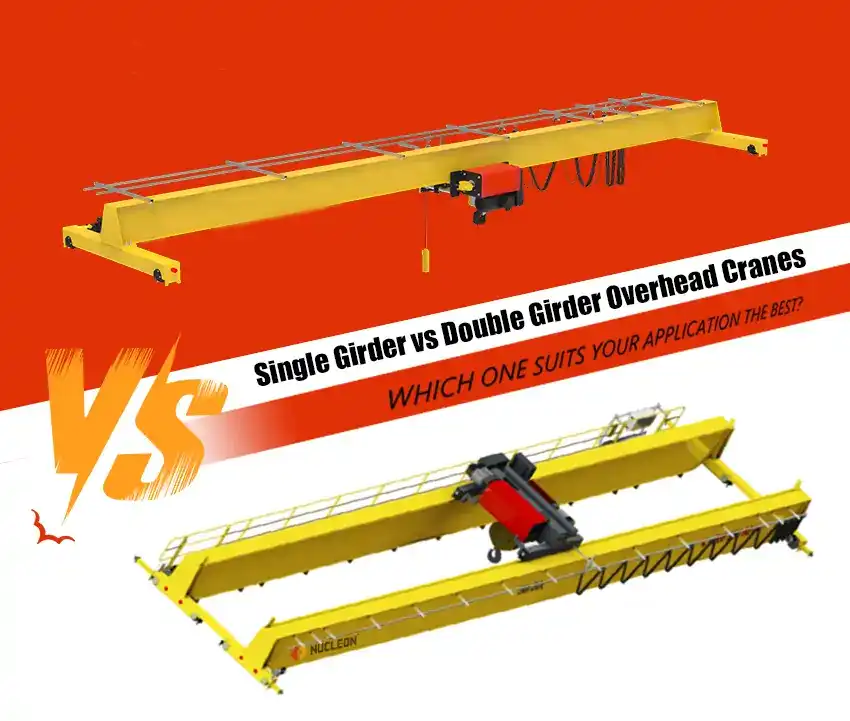
Single Girder Bridge Cranes: The Cost-Effective Workhorse
On a single girder crane, the bridge consists of one girder beam supported on each side by an end truck. The trolley and hoist are most commonly underhung—meaning they run on the bottom flange of the bridge. The bridge itself can either be top running or under running in design.A single girder crane is often the go-to choice for general-purpose material handling. Because of its simpler design, it requires less material and is lighter overall .
Advantages
Lower Initial Investment: The most significant advantage. Lower material costs and simpler engineering make this the most budget-friendly option .
Reduced Deadweight: The lighter crane structure imposes lower loads on your building"s support columns and runway beams. This can save money on new construction or allow for installation in existing buildings without extensive structural reinforcement .
Low Headroom Design: Since the hoist is mounted below the girder, it maximizes the lift height in facilities with low ceiling clearance .
Limitations
Limited Capacity & Span: Generally suited for capacities up to 20 tons and spans less than 65-80 feet. Beyond these limits, deflection becomes a significant issue .
Slower Duty Cycles: Typically designed for light to moderate use (e.g., maintenance, workshops, shipping/receiving), not for continuous, high-speed production .
Restricted Hook Height: Compared to a double girder in the same building, the hook height is lower because the hoist takes up space below the bridge .
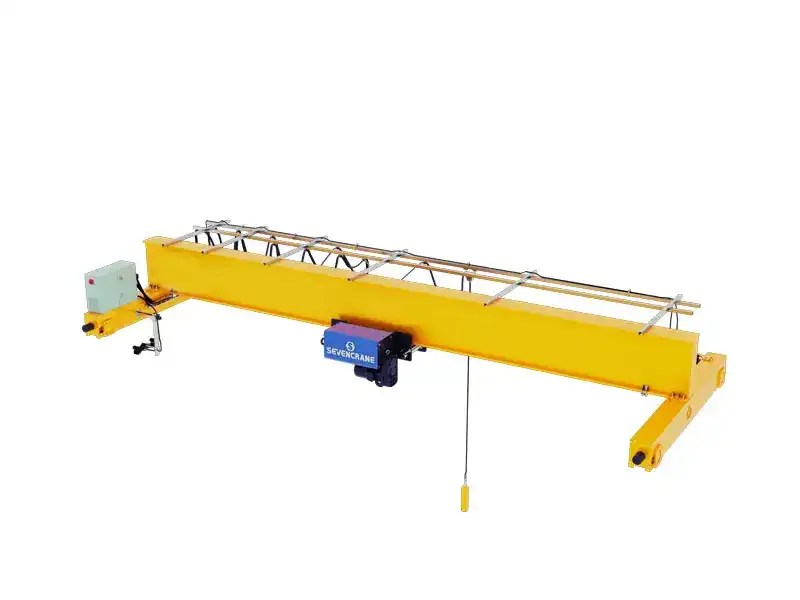
Double Girder Bridge Cranes: The Heavy-Duty Powerhouse
On a double girder crane, there are two girder beams that make up the bridge and they’re supported by an end truck on each side. In most instances, the trolley and hoist run on a rail installed on top of the bridge girders. With a double girder design, you gain the depth of the cross girder if the hoist is placed between or on top of the cross girders—providing an extra 18”-36” of hook height in most cases.
Double girder cranes can be either top running or under running in design. A top running double girder bridge crane will provide the most overhead room, as well as the greatest hook height.
When you move into high-capacity territory or need to maximize productivity, the double girder design becomes the industry standard. Its robust construction provides superior rigidity .
Advantages
Superior Capacity & Span: Double girder cranes handle the heavy lifting—commonly from 10 tons to over 100 tons. They are also the only viable choice for long spans, maintaining structural integrity without excessive deflection .
Maximum Hook Height: Because the trolley runs on top of the rails, the hoist sits higher. This provides greater lift height within the same building profile compared to a single girder .
Higher Duty Cycles: Built for severe service, these cranes handle faster speeds and more frequent lifts, making them essential for demanding environments like steel mills and foundries .
Integrated Maintenance Access: It is easier and safer to add features like walkways, cabs, and platforms on top of the girders, allowing maintenance crews to service components without interfering with floor operations .
Limitations
Higher Cost: The additional materials and complex engineering result in a higher purchase and installation price .
Heavier Load on Building: The crane itself is heavier, requiring more robust (and expensive) building support structures .
Requires More Headroom: The top-running design consumes vertical space above the rails, which may not be feasible in buildings with height restrictions .
What is the Structural Difference?
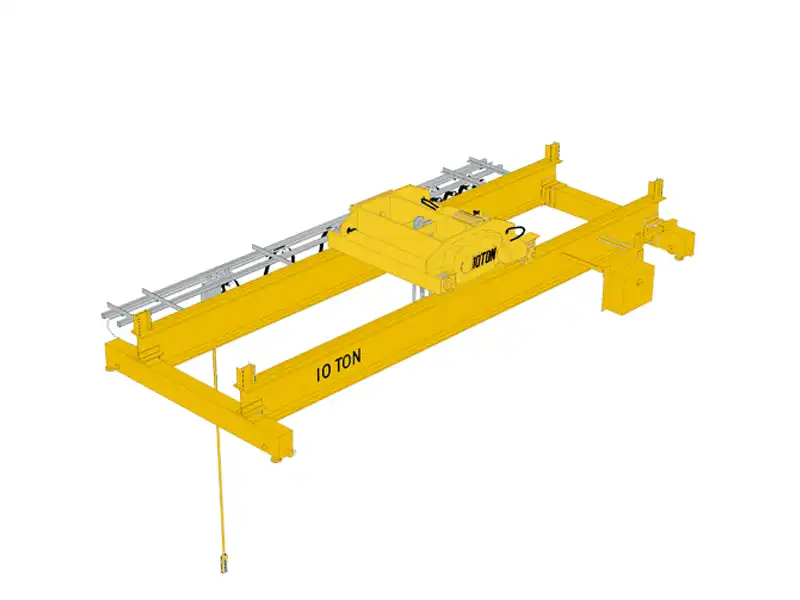
The distinction is exactly what it sounds like: the number of bridge girders.
Single Girder Crane: This design utilizes a single beam (the girder) that spans the width of the bay. The hoist and trolley are typically underhung, meaning they run on the bottom flange of this single beam .
Double Girder Crane: This design consists of two parallel beams that span the bay. The trolley and hoist run on rails mounted on top of these girders, placing the hoist mechanism between the two beams .
Head-to-Head Comparison
To make the decision easier, here is how the two types stack up against the key selection criteria
| Feature | Single Girder Crane | Double Girder Crane |
|---|---|---|
| Initial Cost | Lower (Most economical) | Higher (Significant investment) |
| Lifting Capacity | Light to Medium (Typically up to 20T) | Medium to Heavy (10T to 100T+) |
| Span Capability | Best for short to medium spans | Required for long spans (over 80ft) |
| Hook Height | Lower (Hoist below girder) | Higher (Hoist between girders) |
| Duty Cycle | Light to Moderate | Moderate to Severe / Continuous |
| Maintenance Access | More restricted | Easy access via walkways on top |
| Building Support | Lighter; may use existing structure | Heavier; requires robust support |
How to Choose: 5 Critical Questions to Ask
Before calling a manufacturer, answer these questions to define your scope of work :
1. What is the Maximum Load?
If your heaviest lift is under 15-20 tons, a single girder is likely sufficient. If you are consistently lifting 15 tons or more, a double girder is the safer, more durable choice .
2. What is the Span of the Bay?
Measure the distance between the runway rails. For spans exceeding 65 to 80 feet, a double girder crane is usually necessary to prevent the bridge from flexing (deflecting) under load .
3. How Much Headroom Do You Have?
If your building has low ceilings and you need to maximize the lift, a single girder crane utilizes the space better. If you have tall bay clearance and need the hook to reach as high as possible, a double girder offers the best lift .
4. What is the Duty Cycle?
How many hours per day will the crane run? Is it moving heavy steel every 10 minutes, or moving pallets a few times a day? High frequency and speed demand the durability of a double girder crane .
5. What is Your Total Budget?
Look beyond the purchase price. While a single girder saves money upfront, a double girder might offer a lower total cost of ownership over 20 years if your application requires heavy use, due to its durability and reduced maintenance needs .
Conclusion
There is no universal "best" crane—only the best crane for your specific application.
Choose a Single Girder Bridge Crane if you are looking for a cost-effective solution for light-to-medium duty work, have headroom constraints, or are working within a tight budget .
Choose a Double Girder Bridge Crane if you need to handle heavy loads exceeding 15 tons, require long spans, operate at high speeds, or need a machine that can withstand 24/7 continuous operation .
Henan Mining Cranes Co., Ltd. is a leading crane manufacturer in China. With decades of industry experience, we have become a trusted partner in the global material handling solution field. We are committed to providing comprehensive professional services tailored to your specific needs. We recommend the most suitable crane products, offer accurate quotations, and design customized solutions. Welcome to contact us.
Get In Touch
Email: sale@henanminecranes.com
Website: https://henanminecrane.com/
Whatsapp:16627702870
phone:+86-0373-3088011